2025-05-26
Settlers of ‘’Havad Jal’ad’’ Burn 4 Dunams Planted with Olive in Far'ata Village / Qalqilya Governorate
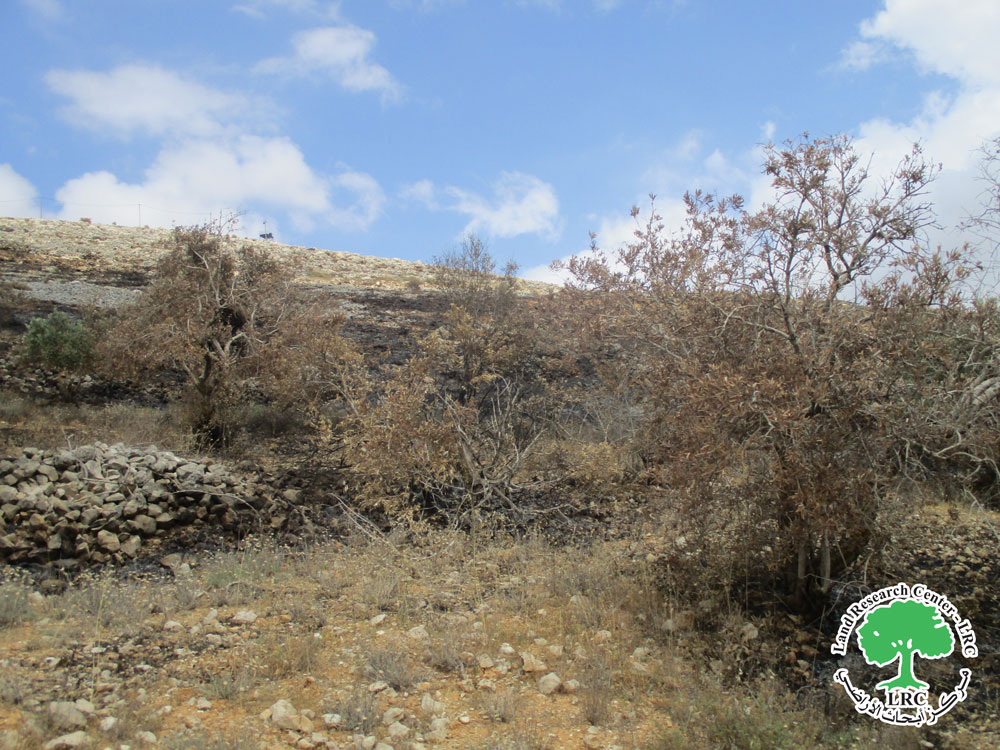
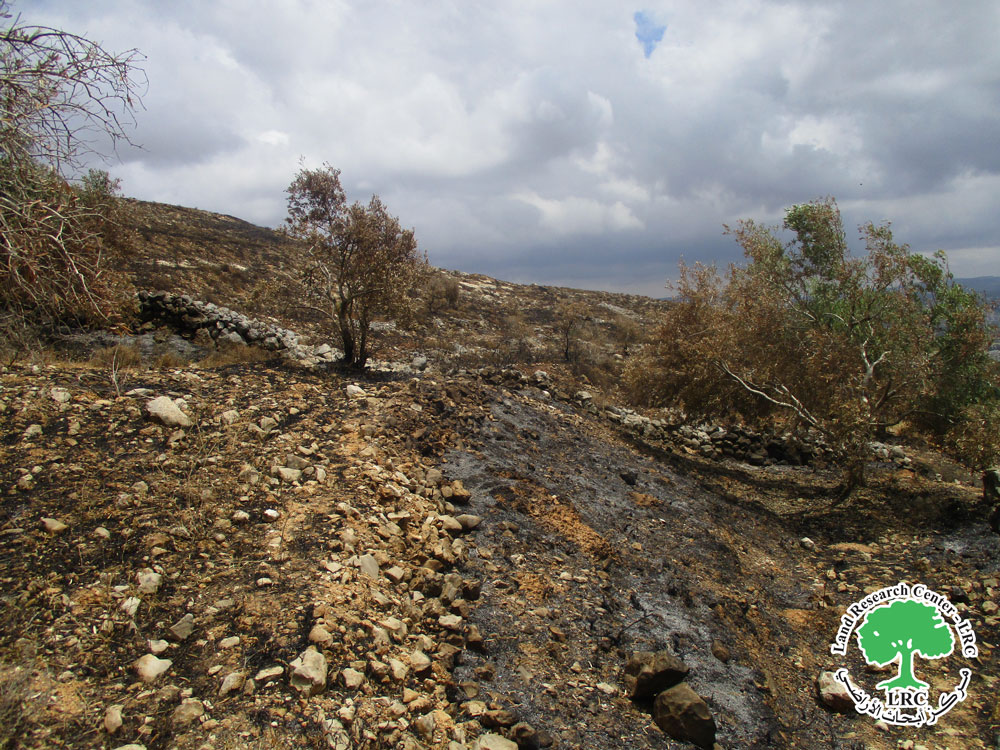
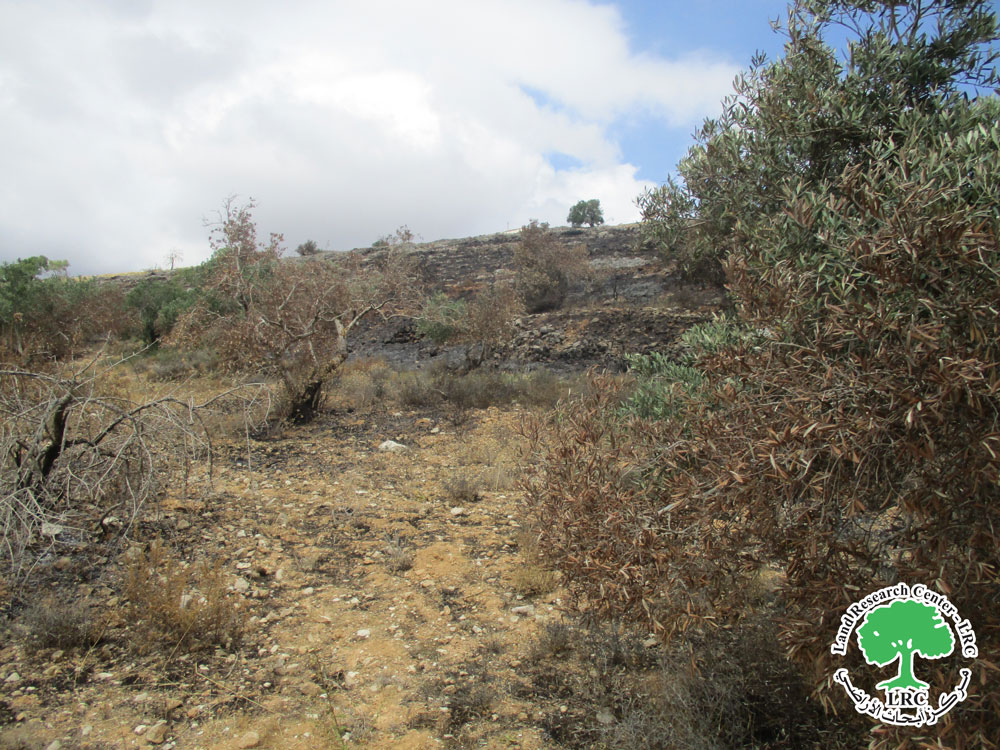
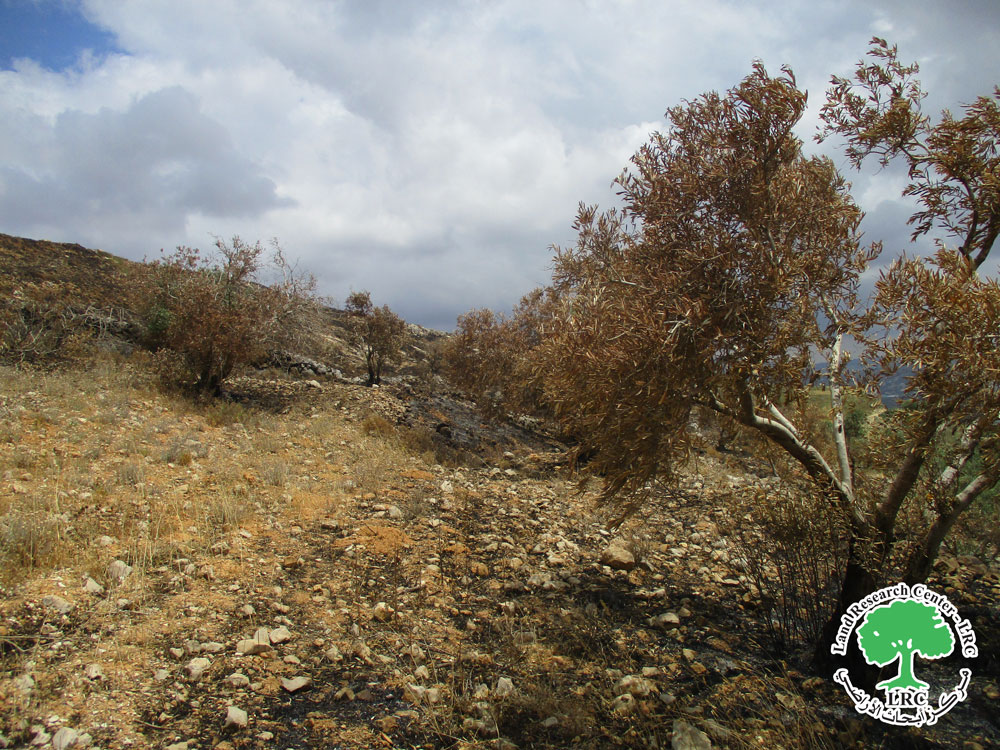
Violation: Burning 40 olive trees.
Location: Far’ata village, east Qalqilya.
Date: May,26th 2025.
Perpetrator: Colonial outpost’’ Havad Jal’ad’’.
Affected party: Farmer Mohammad Mahmoud Suliman.
Details:
Settlers of Havat Jal’ad located on parts of Far’ata village continue their attacks on the agricultural lands near from this outpost, causing damage with aim of preventing farmers to accessing and planting their lands.
A group of settlers attacked olive groves in city outskirts within Al Sawana area north of the village, as they targeted a piece of land planted with fruitful olive and set fire as result as burning over 40 olive trees aging 30 years old, as the high temperature contributed to expending the fire in the land.
These trees belong to farmer Mohammad Mahmoud Salman, who supports a family consisting of 3 members, including 2 females as he told as follows:
‘’ Since the beginning of the war on Gaza, I suffer from accessing my land and harvesting the olive crops, noted that my land far just few meters away from the outpost “Havad Jal’as’’. During last months, it was a noted an activity for settlers as they walked around the groves and threw burning materials in my land that planted with olive trees, as I didn’t check up the land due to they prevent me to accessing my land for two years, as the fire spread quickly and damaged the trees. We tried to accessing the land but the occupation preventing us from entering and at the end they permit to Palestinian civil defense vehicles to accessing after 40 olive trees were destroyed. these trees were produced about no less than 15 tins of olive oil in olive season.
It's noted that this attack was repeated several times over past years and documented large numbers of it, which large areas were damaged.
It’s worth noting that since the declaration the war on Gaza since 2023 and ‘’Havat Jal’ad’’ settlement closed off large areas of lands more than 600 dunams from Far’ata lands, as the farmers preventing from checking their lands or accessing it. In the same time that settlers continue damaging and vandalizing agricultural crops.
It’s noted that Havat Jal’at settlement established at the beginning of 2002 by a group of settlers on the lands of Tal Jeet, Fer’ata east Qalqilya because of ‘Jal’at Zar’ killing in this area. In 2010, the Israeli court issued an Important order that preventing the occupation forces to evict Havat Jal’ad outpost, as thefather of the son who is killed claims that he has papers that belongs to him.
The Israeli attorney general, Afehay Mandalblet has recommended the legalization of the colonial outpost ‘’Havad Jal’ad’’ east Qalqiliya, turning into recognized settlement.
Since the establishment of the settlement until now, settlers’ attacks continue such as burning agricultural crops and broke the trees and raided Palestinian villages at night, noted that the group that live in this colonial outpost known for being religious extremes controlled by ideology of sabotage and killing Arabs.
About Far’ata:
It is located 20km east of Qalqiliya. The village is edged by Jit village from the north, and Immatin village from the west, Tel village from the east and Immatin from the south.
Far'ata's total population reaches up to 642 people until 2007 where the land area totals around 1675 dunums of which 84 dunums are built-up area.
The segregation wall (690m in length) destroyed and ravaged around 67 dunums as for its construction path.
The village lands are classified as area (B&C) according to Oslo Accords. Area classified B represent 90% where area classified C represents 10% of the total land area. The percentage in dunums is explained as follows:
- 1493 dunums are classified as area B.
- 164 dunums are classified as area C.
Burning agricultural Lands a form of Israeli Violations of Palestinian Environment:
Agriculture is a fundamental pillar for several families, as it provides food security and meets their essential needs. Palestinian farmers also rely on it as a primary source of income. However, in recent times, agriculture has become a difficult and perilous challenge, with those who cultivate their land suffering significant losses due to the escalating acts of aggression by settlers, carried out under the protection—and often with the direct participation – of Israeli occupation forces. The core of the conflict lies in the land itself, which is subjected to widespread destruction, including bulldozing, vandalism, poisoning, and flooding with wastewater, culminating in the burning of trees and crops. these actions contaminate the air and soil without any deterrence or accountability.
In addition to ongoing confiscation of land, the denial of farmers’ access to their lands , and the closure of many agricultural roads, settlers and the occupation forces have recently intensified their acts of burning crops and trees. As a result, the settlers are causing significant environmental damage to the Palestinian land and it’s surrounding. This action involve the use of plastic materials and chemical pesticides, which release various pollutants into the air, causing distress and harm to humans , animals and agricultural produce.
Despite the fact that the Israeli Ministry of Environmental Protection is the responsible authority for environmental protection and pollution control, as stated on its official website—where it mentions that "air pollution does not stay in one place, nor does it know borders; it spreads according to climate conditions, winds, temperature, and humidity"—the primary contributors to air pollution are the settlers in the settlements and outposts across the West Bank. The burning of agricultural structures, trees, crops, other buildings, and even Palestinian homes and vehicles is a widespread practice among settlers.
According to the Israeli Criminal Procedures Order of 2022, "burning waste in an illegal location is subject to a fine of 2,000 shekels for an individual and 12,000 shekels for a company." The order further acknowledges that such practices can lead to chronic illnesses and an increased risk of cancer due to the inhalation of toxic substances.
The burning of such agricultural rooms is no less harmful than burning waste; in fact, it is even more detrimental because it occurs on agricultural land that is privately owned by Palestinians. Therefore, the violation should be considered more severe due to the illegal entry onto someone else's property and the environmental harm caused.
Undoubtedly, the actions of the Israeli side violate not only international laws but also Israeli laws themselves. Referring to the details of this case, the Israeli Penal Code of 1977 and its amendments stipulate that trespassing on someone else's property with the intent to commit a crime is punishable by law. Article 447 of the Penal Code states:
"Anyone who does any of the following with the intent to intimidate, insult, or harass the property owner, or to commit a crime, shall be punished with imprisonment for two years:
(1) enters or crosses the property;
(2) enters the property unlawfully."
(b) A crime is committed under this section if the offender carries a firearm or a sharp weapon, and the punishment is imprisonment for four years.
Reading the text of this article, it is clear that the Israeli Penal Code criminalizes the mere act of entering someone else's property without authorization, with the intent to insult, harass, or intimidate, and punishes it with a two-year prison sentence. The punishment is doubled if the offender enters the property and commits a crime, such as using a weapon or sharp tool, or even vandalizing agricultural land by cutting, burning, or destroying it. This is explicitly prohibited in the text of the aforementioned Penal Code.
مشروع: حماية الحقوق البيئية الفلسطينية في مناطق "ج" SPERAC IV - GFFO
Disclaimer: The views and opinions expressed in this report are those of Land Research Center and do not necessarily reflect the views or positions of the project donor; the Norwegian Refugee Council.
إخلاء المسؤولية: الآراء ووجهات النظر الواردة في هذا التقرير هي آراء ووجهات نظر مركز أبحاث الأراضي ولا تعكس بالضرورة وجهات نظر أو مواقف الجهة المانحة للمشروع؛ المجلس النرويجي. للاجئين
The effects of burning Far’ata village lands