2025-06-30
Settlers Burn 300 Dunams from Sa'ir Town’s lands, East Hebron
Violation: Burning agricultural lands.
Location: Sa’ir town/ Hebron governorate.
Date: June,30th 2025.
Perpetrators: Settlers.
Affected party: Farmers from Shalaleh family.
Details:
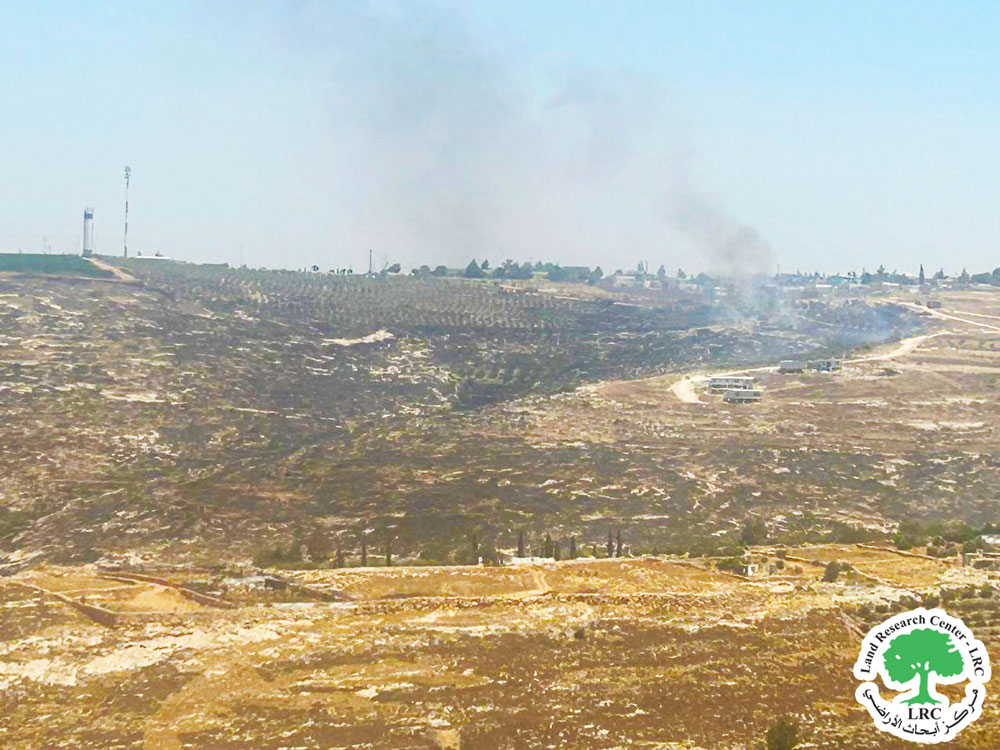
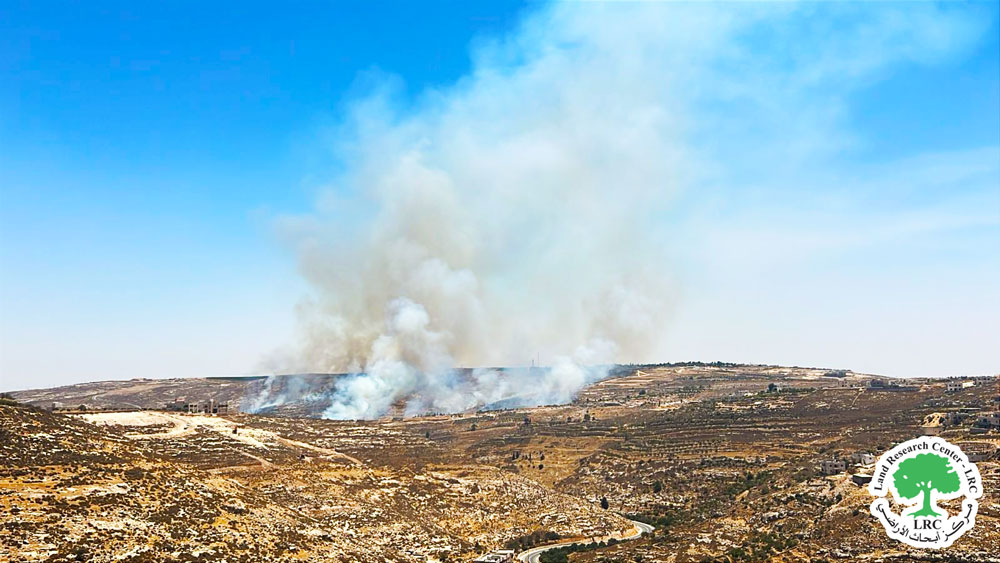
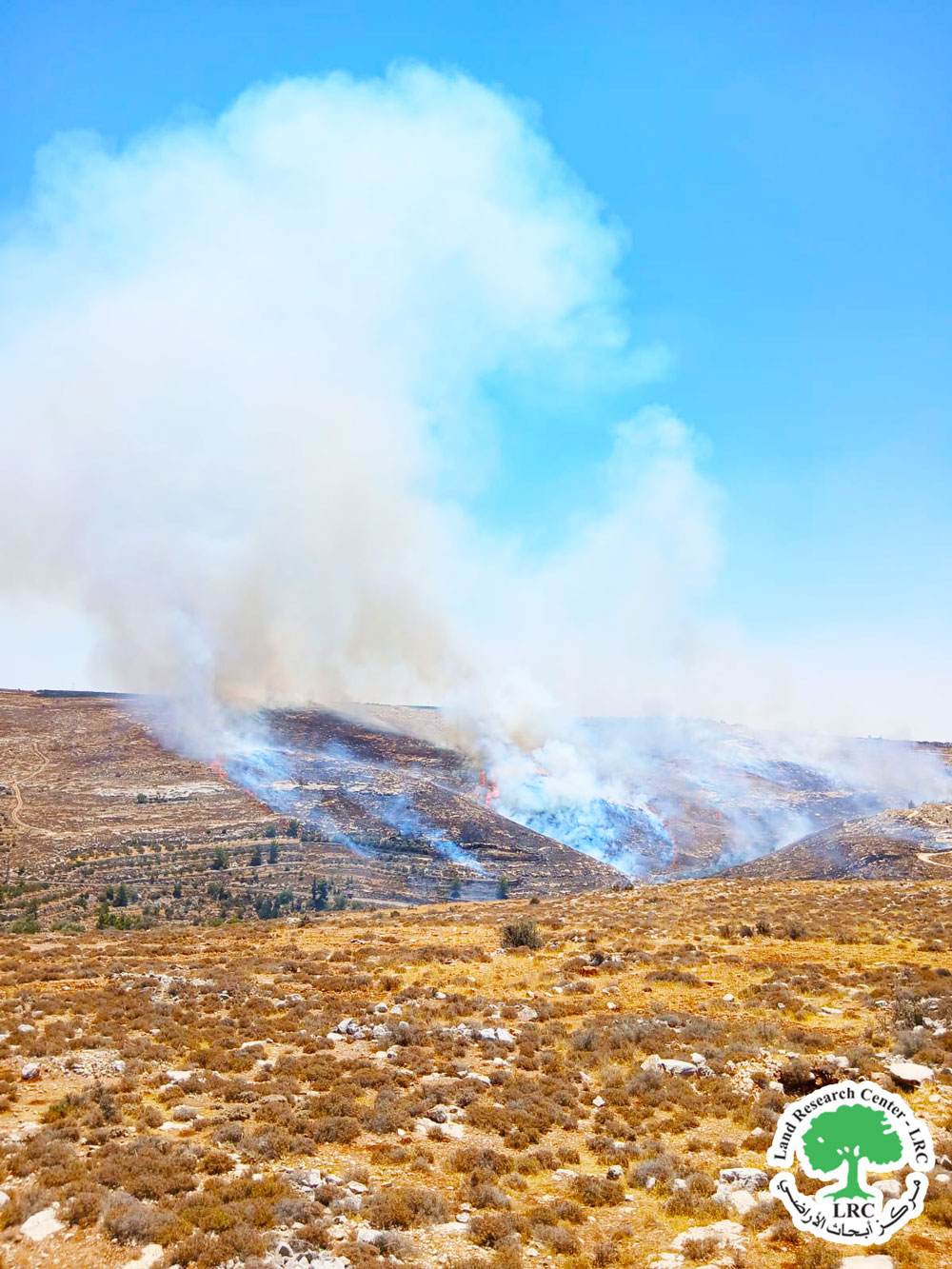
Settlers from colonial outpost located on Sa’ir town lands, east Hebron governorate set fire in the farmers’ lands, causing severe damages.
According to farmers, around 12 pm, Monday, June, 30th 2025, a group of settlers attacked ‘’Jourat Al Khail ‘’community east town, they were forced displacement due to these attacks, as the Israeli occupation soldiers pursuing them and deporting settlers from the community, then settlers came back and set fire in agricultural lands, to preventing them from attacking what remains in ‘’Jourat Al Kail’’.
The affected farmer, Mohammad Rabe’a Kamal Shaladeh(34 years) stated as follows:
‘’ I was near the location of the lands assault, noticed that the occupation soldiers and the police trying to push settlers back. After 10 minutes we saw smoke rising from our lands in Khalit Kizma, the high temperature of midday helped to spreading the fire quickly, which almond and olive groves were burned then moved uphill, mountain and pastoral lands. The residents and the landowners were gathered near the attacked location, we contacted with Palestinian Civil liaison to sending a vehicle to extinguish the fire, but the dangerous of the location and settlers’ attacks continue without any existing of the civil defense, the fire is rising up until approaches near to a colonial outpost and grape field, near to Asfar settlement.’’
Shalaldeh noted that the fire is extended to lands belong to citizens from his family, about 300 dunams were burned, including 170 dunams planted with olive trees, almond and grapes aging 40 years, as 200 members were relied on them including 120 children.
It’s noted that farmers were prevented from accessing their lands due to the settlers’ attacks, as the same settlers preventing them in last year from cultivated olive trees and various crops in the same location.
It’s worth mentioning the attacked lands located near Khirbet Jourat Al Khail, which two years ago forced displacement due to the settlers’ attacks from colonial outpost and Asfar settlement near to the location.
These links show the settlers’ attacks on the area in October, 7th 2023:
- Settlers are forcing Jourat Al Khail gathering to leave in East Sa’ir/ Hebron Governorate.
- Settlers confiscate lands in Khirbet Jourat Al Khail and they are establishing a new colonial outpost on it- Sa’ir town, east Hebron.
- The occupation demolishes structures and homes in Khirbet Jourat Al Khail in Sa’ir town, east Hebron.
- Settlers destroy an agricultural project belongs to woman from Al Shalaldeh family in Jourat Al Khail, east Sa’ir/ Hebron governorate.
- Forced Displacement Attempts: Settlers Attack Farmers' Land and Livestock in Jorat al-Khail East of Sa'ir / Hebron Governorate
Burning Agricultural lands and Its Environmental Impact:
Agriculture is a fundamental pillar for several families, as it provides food security and meets their essential needs. Palestinian farmers also rely on it as a primary source of income. However, in recent times, agriculture has become a difficult and perilous challenge, with those who cultivate their land suffering significant losses due to the escalating acts of aggression by settlers, carried out under the protection—and often with the direct participation – of Israeli occupation forces. The core of the conflict lies in the land itself, which is subjected to widespread destruction, including bulldozing, vandalism, poisoning, and flooding with wastewater, culminating in the burning of trees and crops. these actions contaminate the air and soil without any deterrence or accountability.
In addition to ongoing confiscation of land, the denial of farmers’ access to their lands, and the closure of many agricultural roads, settlers and the occupation forces have recently intensified their acts of burning crops and trees. As a result, the settlers are causing significant environmental damage to the Palestinian land and it’s surrounding. This action involve the use of plastic materials and chemical pesticides, which release various pollutants into the air, causing distress and harm to humans, animals and agricultural produce.
Despite the fact that the Israeli Ministry of Environmental Protection is the responsible authority for environmental protection and pollution control, as stated on its official website—where it mentions that "air pollution does not stay in one place, nor does it know borders; it spreads according to climate conditions, winds, temperature, and humidity"—the primary contributors to air pollution are the settlers in the settlements and outposts across the West Bank. The burning of agricultural structures, trees, crops, other buildings, and even Palestinian homes and vehicles is a widespread practice among settlers.
According to the Israeli Criminal Procedures Order of 2022, "burning waste in an illegal location is subject to a fine of 2,000 shekels for an individual and 12,000 shekels for a company." The order further acknowledges that such practices can lead to chronic illnesses and an increased risk of cancer due to the inhalation of toxic substances.
The burning of such agricultural rooms is no less harmful than burning waste; in fact, it is even more detrimental because it occurs on agricultural land that is privately owned by Palestinians. Therefore, the violation should be considered more severe due to the illegal entry onto someone else's property and the environmental harm caused.
Undoubtedly, the actions of the Israeli side violate not only international laws but also Israeli laws themselves. Referring to the details of this case, the Israeli Penal Code of 1977 and its amendments stipulate that trespassing on someone else's property with the intent to commit a crime is punishable by law. Article 447 of the Penal Code states:
"Anyone who does any of the following with the intent to intimidate, insult, or harass the property owner, or to commit a crime, shall be punished with imprisonment for two years:
(1) enters or crosses the property;
(2) enters the property unlawfully."
(b) A crime is committed under this section if the offender carries a firearm or a sharp weapon, and the punishment is imprisonment for four years.
Reading the text of this article, it is clear that the Israeli Penal Code criminalizes the mere act of entering someone else's property without authorization, with the intent to insult, harass, or intimidate, and punishes it with a two-year prison sentence. The punishment is doubled if the offender enters the property and commits a crime, such as using a weapon or sharp tool, or even vandalizing agricultural land by cutting, burning, or destroying it. This is explicitly prohibited in the text of the aforementioned Penal Code.
مشروع: حماية الحقوق البيئية الفلسطينية في مناطق "ج" SPERAC IV - GFFO
Disclaimer: The views and opinions expressed in this report are those of Land Research Center and do not necessarily reflect the views or positions of the project donor; the Norwegian Refugee Council.
إخلاء المسؤولية: الآراء ووجهات النظر الواردة في هذا التقرير هي آراء ووجهات نظر مركز أبحاث الأراضي ولا تعكس بالضرورة وجهات نظر أو مواقف الجهة المانحة للمشروع؛ المجلس النرويجي. للاجئين
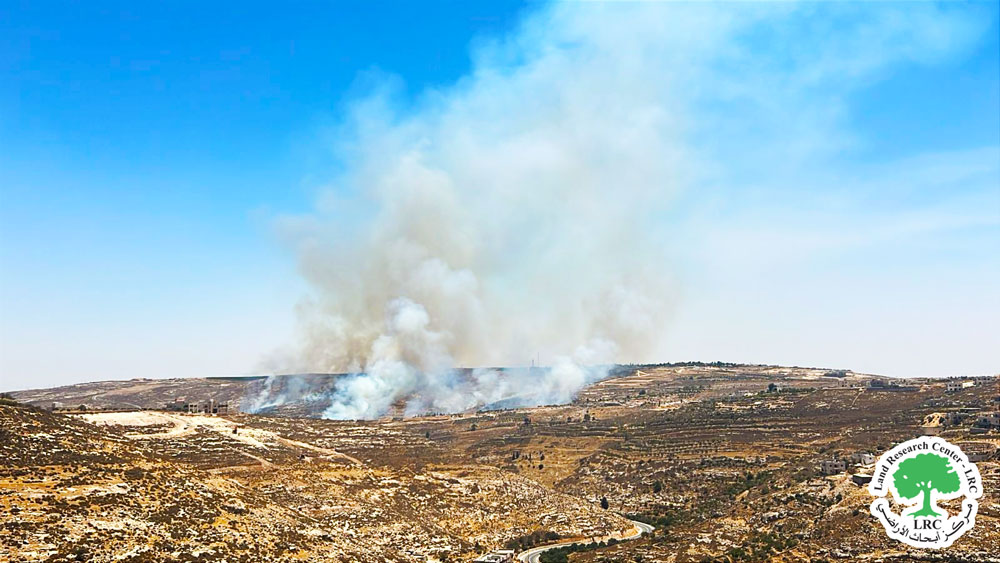
Photos show the fire in the farmers’ lands in Sa’ir town