2026-01-12
Environmental Targeting of Agricultural Lands: Israeli Occupation Demolishes Agricultural Facility and Water Wells in Beit Ummar Town, North of Hebron
Violation: Destruction of agricultural facilities and water resources.
Date: 12/01/2026.
Location: Beit Ummar Town / Hebron Governorate.
Perpetrators: Israeli occupation authorities – “Civil Administration”.
Victims: Four farmers and agricultural lands in the town.
Beit Ummar is considered one of the key agricultural areas in the Hebron Governorate, where residents primarily depend on rain-fed and irrigated agriculture sustained through water wells and rainwater harvesting pools, amid severe water scarcity and the absence of adequate water networks.
Any targeting of agricultural and water infrastructure constitutes a direct threat to environmental sustainability, food security, and the natural ecological balance in the area.
Details
On 12/1/2026, the Israeli occupation authorities carried out demolition operations targeting agricultural structures, water wells, and rainwater harvesting pools in several locations across Beit Ummar under the pretext of lacking permits. Affected farmers reported that Israeli occupation forces, accompanied by demolition crews from the Civil Administration and supported by an excavator and bulldozer belonging to an Israeli civilian company, stormed the town during the morning hours and executed demolitions at multiple sites, resulting in the following environmental damages:
Demolition of a Poultry Farm Structure: The demolished structure belonged to farmer Mohammad Mahmoud Abu Maria and was located in the Al-Freidis area east of Beit Ummar. The facility, covering an area of 150 square meters, was constructed with brick walls and roofed with metal sheets and wood. It was used for raising laying hens, serving as the main source of livelihood for a family of 11 members, including four children and five women.
The demolition caused construction debris and rubble to spread across the site, creating both visual and environmental pollution in the surrounding agricultural lands.
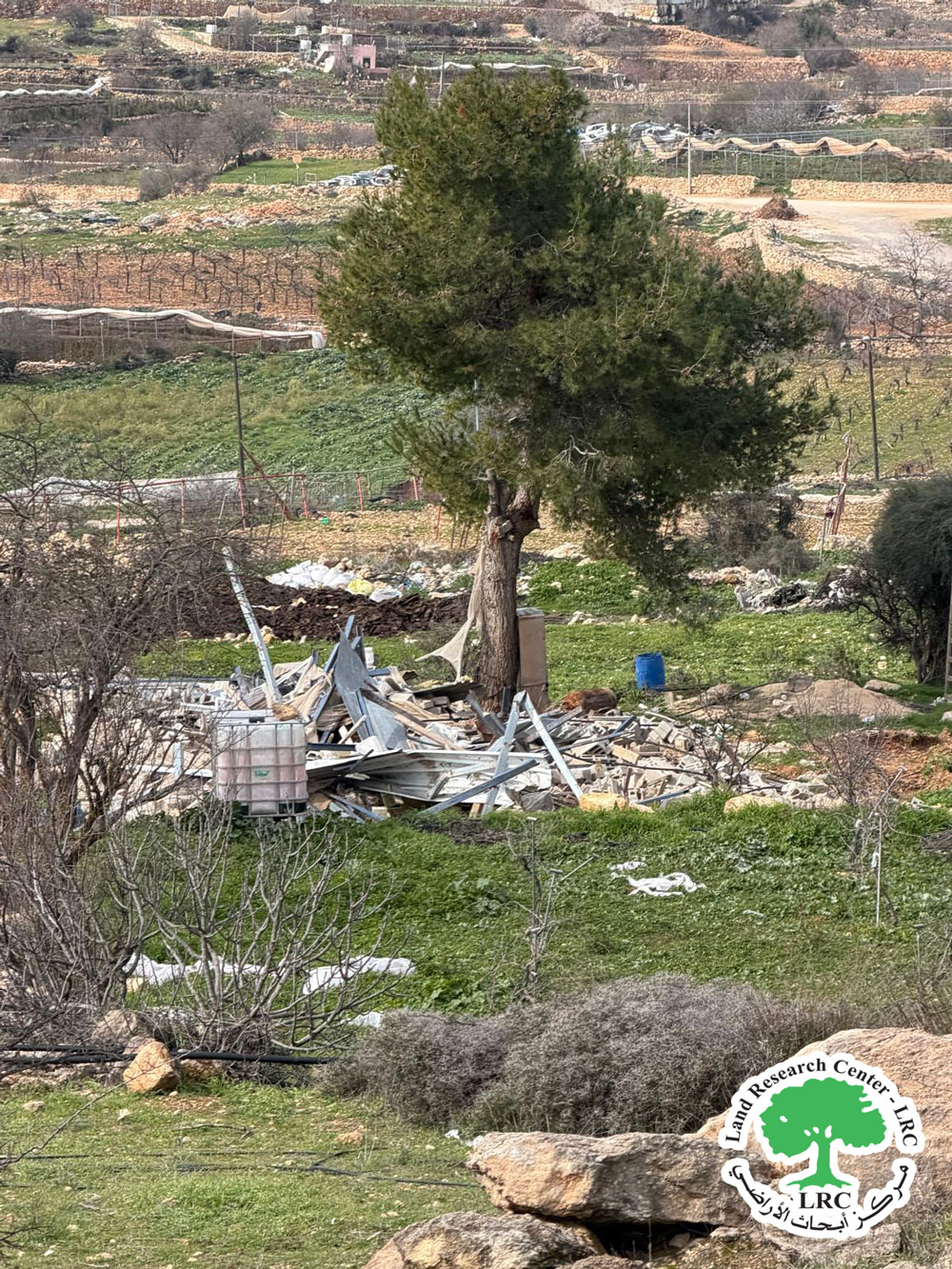
Photo of the rubble of the agricultural barracks demolished by the occupation
The occupation authorities also demolished an adjacent 12-square-meter room used for storing animal feed.
The affected farmer stated:
“The occupation authorities demolished the structure while birds were still inside and did not allow their removal. I managed to gather a few dozen birds and transferred them to my home in Beit Ummar, where I built a small shelter near the house.”
The occupation authorities had previously issued a final demolition order against the facility dated 22/2/2023. The farmer prepared a licensing file and appointed a lawyer to challenge the order, but the authorities rejected his request and proceeded with the demolition.
Demolition of an Agricultural Water Well: The occupation authorities demolished a rainwater harvesting well owned by farmer Jamil Mohammad Alqam, whose family consists of eight members, including one child and four women. The well was located on his agricultural land in the Wadi Al-Wahadin area southeast of the town.
The reinforced concrete well, which had existed for more than four years, had a storage capacity of 150 cubic meters and was used to irrigate vegetables cultivated on four dunums of land.
The destruction of this type of water harvesting facility reduces the capacity of agricultural lands to withstand drought periods and undermines traditional agricultural practices adapted to the local environment.
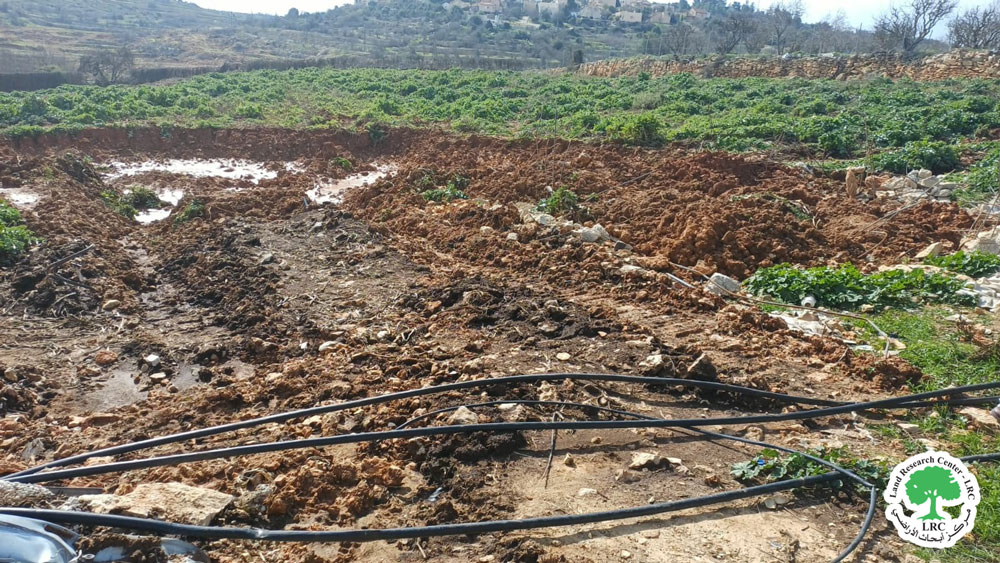
Photo showing the destruction remains of the well belonging to farmer Jamil Alqam
The affected farmer indicated that the occupation authorities had issued a final demolition order against the well on 26/1/2025. Following the demolition, they bulldozed parts of the surrounding land, filled the well with soil, and erased its physical traces entirely.
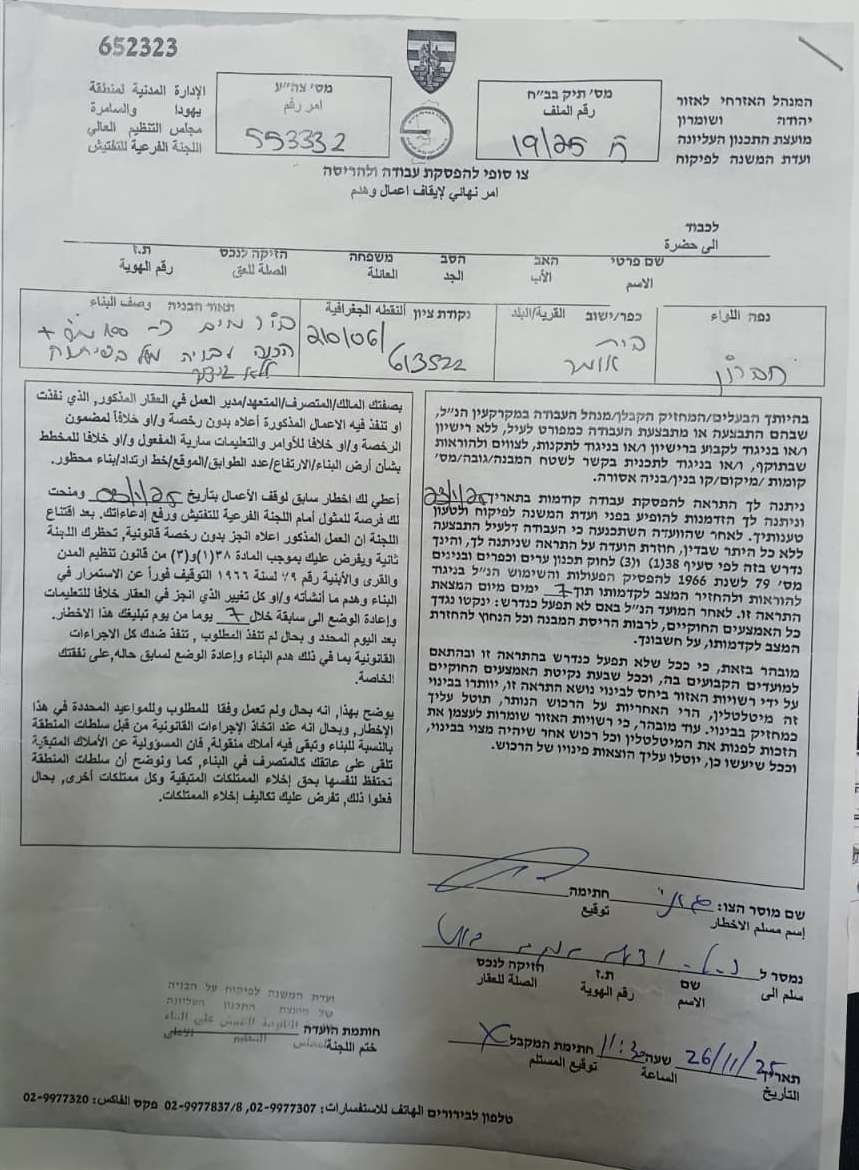
Demolition Order No. 652323 targeting the well of farmer Jamil Alqam
Demolition of an Agricultural Water Pool: The occupation authorities also demolished a water harvesting pool owned by farmer Salama Ali Arar in the Wadi Al-Wahadin area. The pool consisted of an excavated pit lined with plastic sheets and had a capacity of 500 cubic meters of harvested rainwater.
The farmer used the pool to irrigate four dunums of agricultural land planted with grapevines and vegetables.
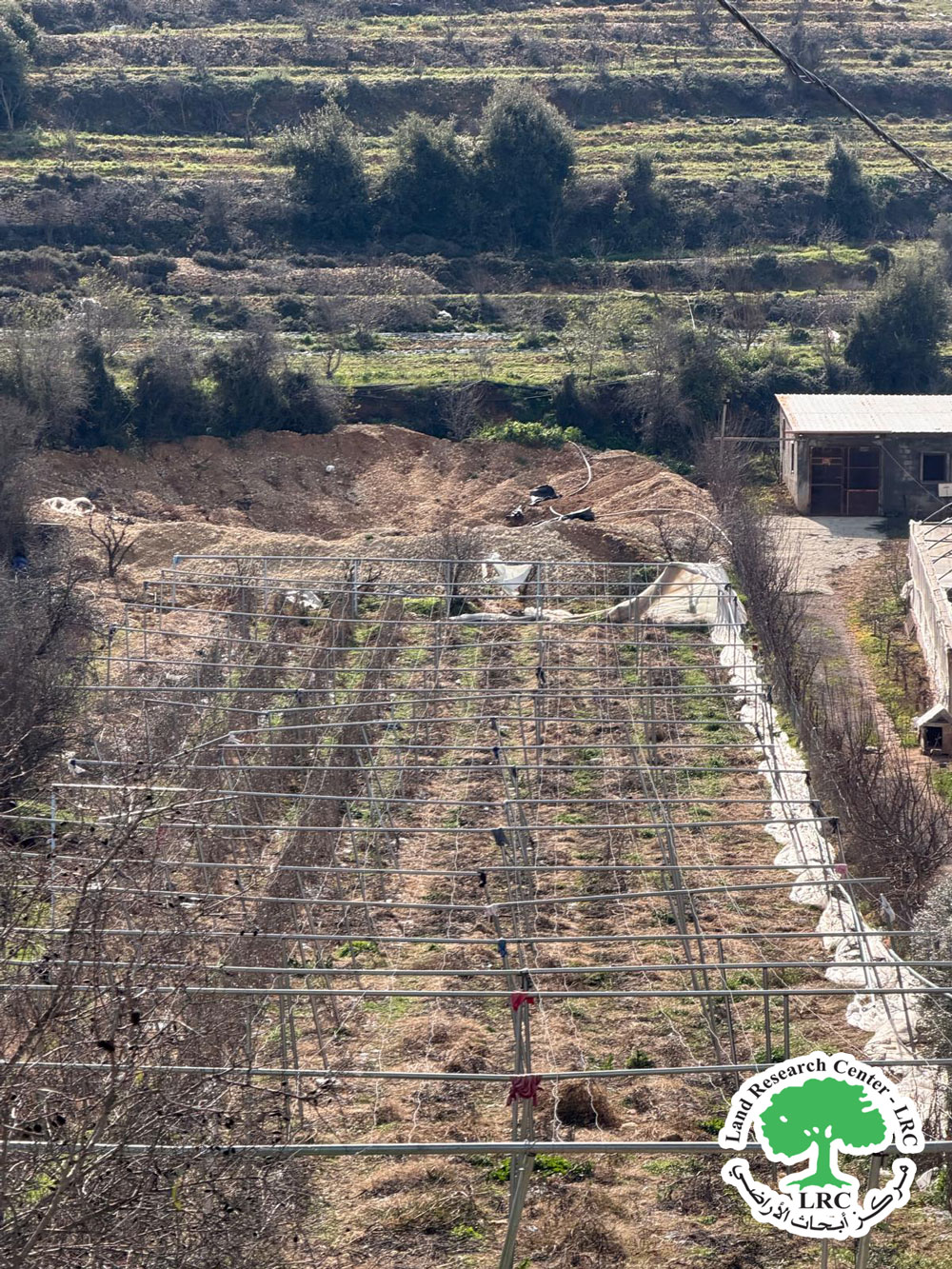
Effects of the Demolition of Farmer Salama Arar’s Water PoolEffects of the Demolition of Farmer Salama Arar’s Water Pool
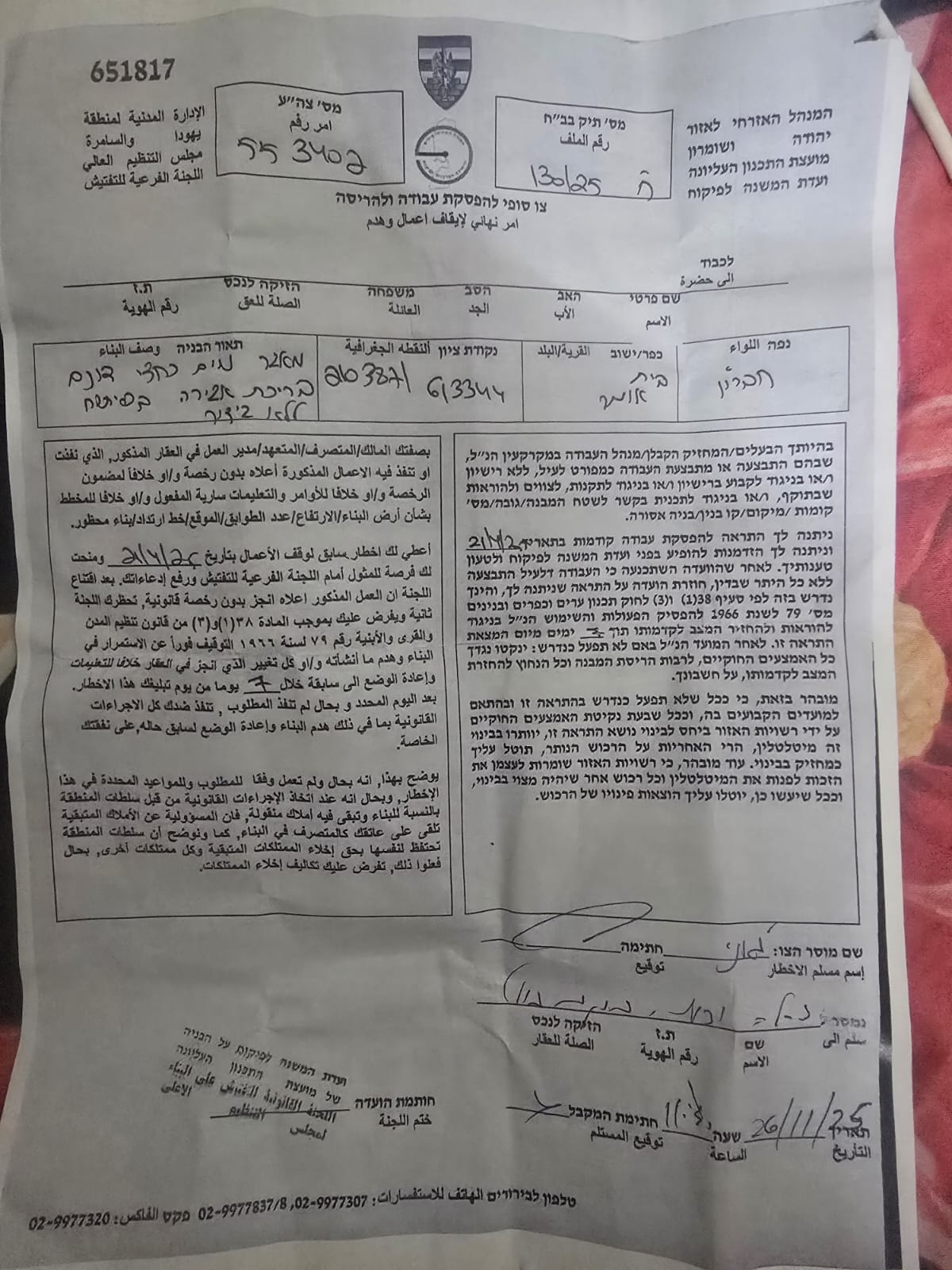
Demolition Order No. 651817 Targeting the Water PoolDemolition Order No. 651817 Targeting the Water Pool
Demolition of Another Agricultural Water Well: Another agricultural water well owned by farmer Hassan Odeh Al-Allami, whose family consists of seven members including five children and three women, was demolished in the Wadi Al-Sheikh area east of Beit Ummar.
The reinforced concrete well was located adjacent to the main road and supplied irrigation water to four dunums planted with productive grapevines. Israeli machinery also destroyed approximately 15 square meters of grape trellises during the operation.
Environmental Impacts Resulting from the Demolition and Bulldozing of Agricultural Facilities and Water Resources
- Destruction of water harvesting resources in an area already suffering from severe water scarcity.
- Decline in the productive capacity of agricultural lands.
- Threats to local food security.
- Increased risks of soil degradation and desertification.
- Damage to ecological balance and vegetation cover.
Demolition of Agricultural Facilities and Its Impact on the Palestinian Environment
The demolition of agricultural facilities and water resources in Beit Ummar represents a clear example of systematic targeting of Palestinian environmental infrastructure. The consequences extend far beyond direct material losses, causing profound disruption to the local ecological system.
The destruction of water wells and rainwater harvesting pools has significantly reduced the ability of agricultural lands to store and sustainably utilize water in a region already suffering from chronic water shortages. This destruction contributes to the depletion of natural resources and forces farmers to rely on distant or costly water sources, leading to declining agricultural activity and land degradation.
Bulldozing activities and the filling of wells with soil have also damaged the structure and fertility of agricultural lands, increasing vulnerability to erosion and desertification. This negatively affects vegetation cover and local biodiversity. The destruction of fruit-bearing trees and grape trellises further reduces green areas that play an essential role in stabilizing soil and regulating the local climate.
Demolition operations are often accompanied by the spread of rubble and construction waste across agricultural fields, creating sources of environmental and visual pollution and negatively impacting microorganisms and surrounding agricultural ecosystems.
On a broader level, these practices contribute to undermining Palestinian environmental security and threaten the right of citizens to access their natural resources. They also weaken the resilience of local communities and their ability to adapt to climate change, particularly in vulnerable agricultural areas.
Accordingly, these demolitions cannot be viewed as isolated administrative measures but rather as actions with cumulative environmental impacts that exacerbate the deterioration of the Palestinian environment, deepen the water and agricultural crisis, and threaten the sustainability of natural resources for future generations.
مشروع: حماية الحقوق البيئية الفلسطينية في مناطق "ج" SPERAC IV - GFFO
Disclaimer: The views and opinions expressed in this report are those of Land Research Center and do not necessarily reflect the views or positions of the project donor; the Norwegian Refugee Council.
إخلاء المسؤولية: الآراء ووجهات النظر الواردة في هذا التقرير هي آراء ووجهات نظر مركز أبحاث الأراضي ولا تعكس بالضرورة وجهات نظر أو مواقف الجهة المانحة للمشروع؛ المجلس النرويجي. للاجئين
