2026-04-12
Settlers Open a Colonial Road in the Lands of Rabud Village, South of Hebron
Violation: Construction of a colonial road.
Date of Violation: 12/04/2026.
Location: Rabud Village – Dura Town / Hebron Governorate
Perpetrators: Settlers
Affected Party: Residents of Rabud Village
Details:
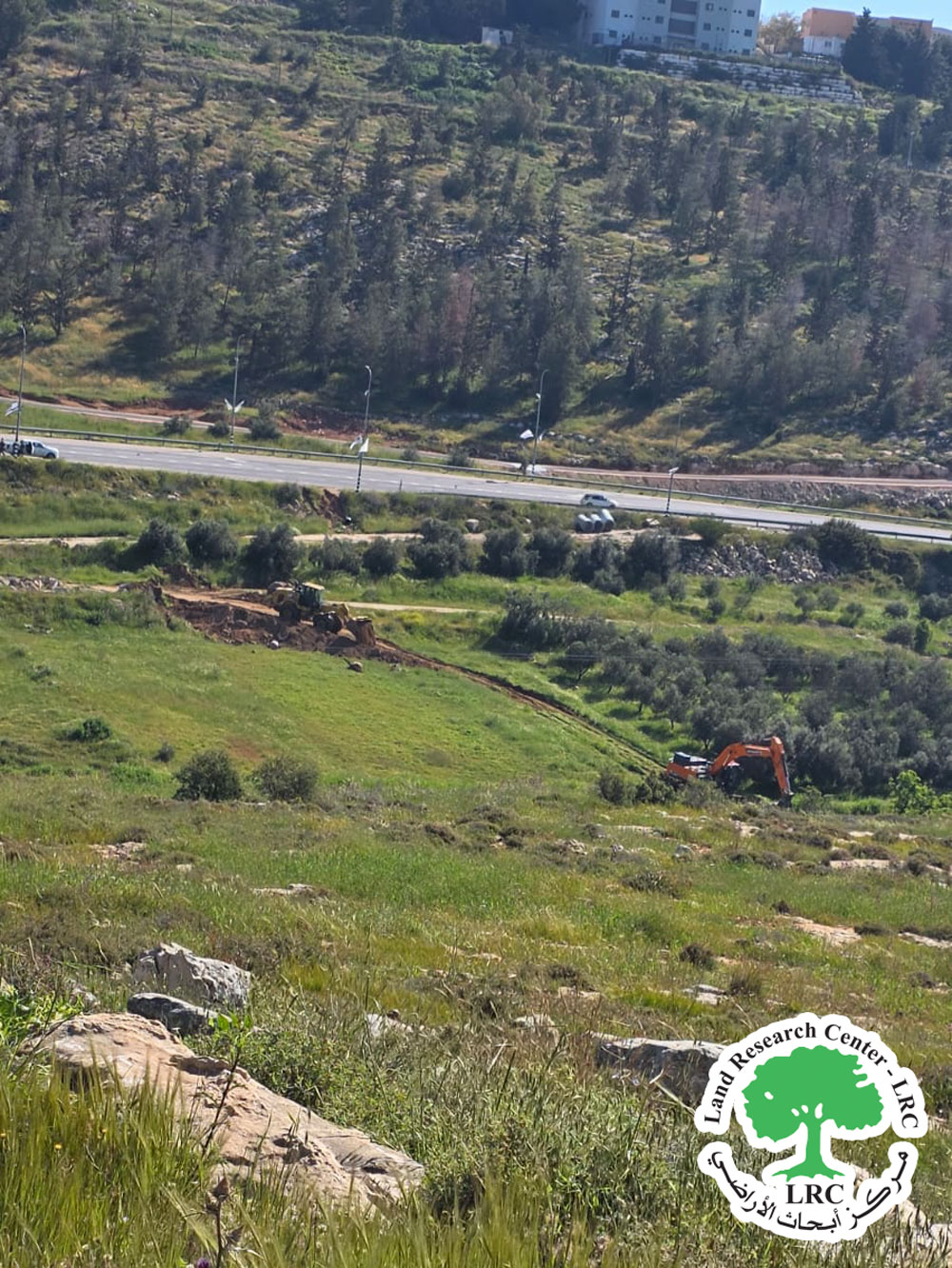
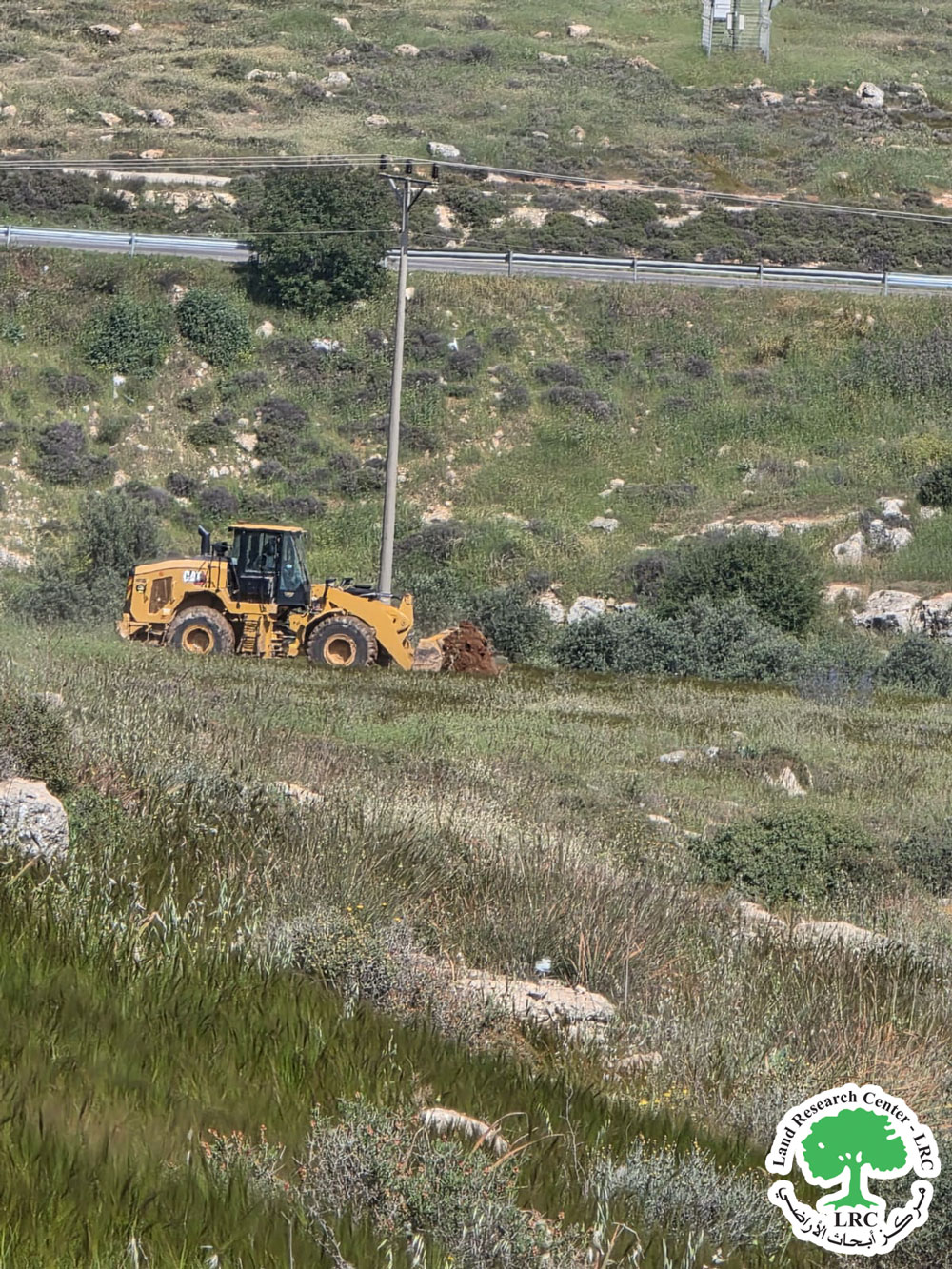
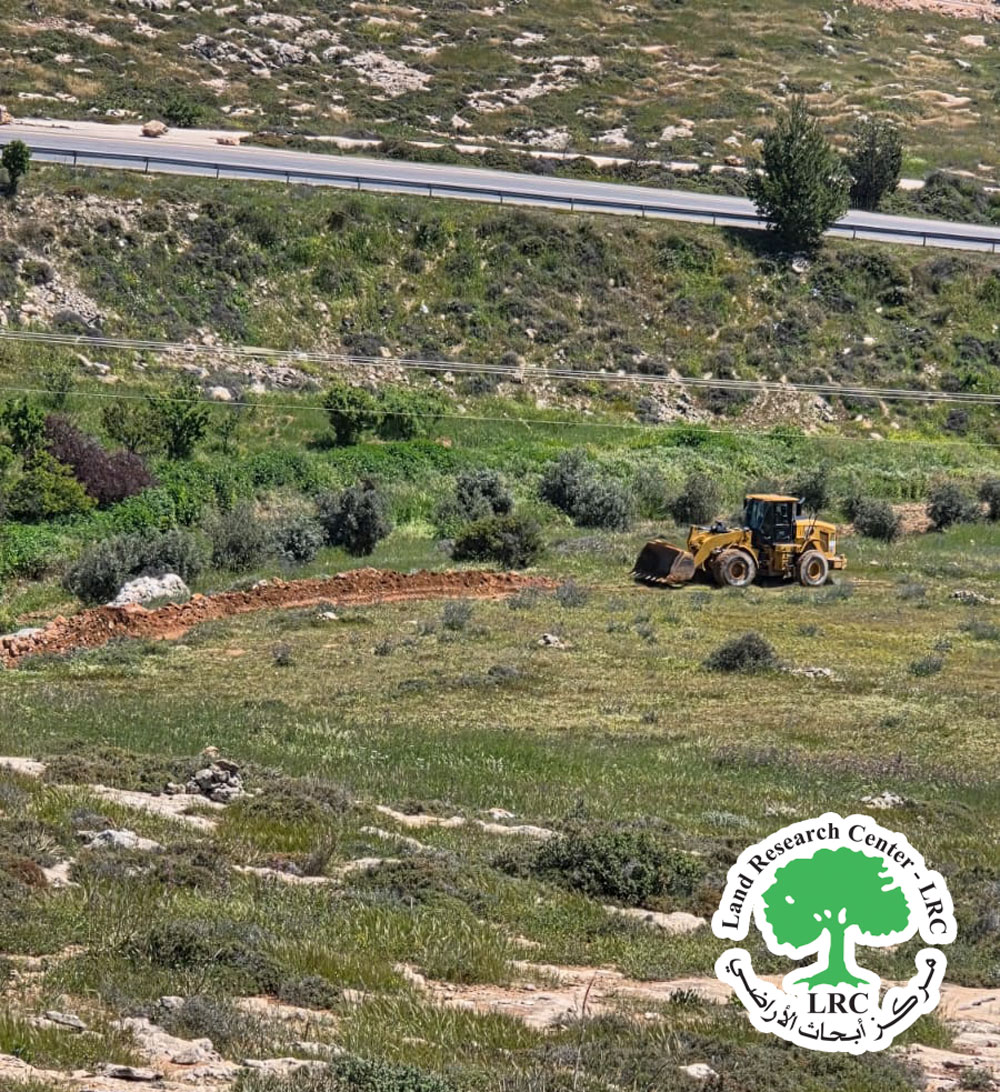
Settlers carried out the construction of a colonial road in the lands of Rabud Village, south of Dura city in the Hebron Governorate. Excavation work began on Sunday, April 12, 2026, when settlers brought in an excavator and a bulldozer and started opening the road along the bypass road (Route 60) east of the village, opposite the Atniel settlement. Initially, the ravaging affected lands belonging to farmers from the nearby village of Karmeh, where the machinery moved along a stretch of about 300 meters, uprooting three almond trees approximately thirty years old.
When the machinery reached a water stream crossing the area, settlers installed prefabricated structures and crossings and passed through the stream toward Rabud village lands.
According to farmer Mahmoud Mohammed Al-Zeer (49 years old), who spoke to the monitoring center,
"Farmers from the village had previously built an agricultural road around 2003, funded by the Ministry of Agriculture. It was about 1.5 kilometers long, narrow, and modest, yet it served thousands of dunams. Settlers seized control of this road and widened and upgraded it, increasing its width to about 10 meters. The road now extends from near the entrance of the Atniel settlement to the archaeological site of Khirbet Rabud in the south of the village. When we asked settlers about the purpose of this road, they claimed it was to serve settlers who wanted to reach the archaeological site for prayer."
Al-Zeer noted that the road passes through farmland planted with almond and olive trees and separates about 120 dunams of farmers’ lands, water wells, greenhouses, and several homes to the east. This road, controlled by settlers, effectively isolates this neighborhood from the rest of the village.
He also indicated that approximately 300 people are affected by this violation, including about 150 children.
Figures 1-3: Excavation works on farmers’ lands in Rabud Village
The construction of new roads at the expense of agricultural lands in Rabud Village, south of Hebron, contributes to the destruction of vegetation cover and the fragmentation of the local ecosystem. It leads to loss of biodiversity and soil degradation. The uprooting of trees and disruption of water resources further exacerbate environmental damage and negatively impact citizens’ livelihoods. Such practices increase pressure on the rural environment and weaken its capacity for sustainability, emphasizing the need to protect natural resources and prevent activities that threaten ecological balance.
Legal Commentary:
The Palestinian environment, in general, is subjected to numerous environmental violations by the Israeli occupation, disregarding all international and national laws and conventions related to the protection of environmental rights. The right to live in a clean and healthy environment is a fundamental human right that has been inherent to mankind since the beginning of creation. The occupation often attempts to present itself as being concerned with international environmental issues, despite having signed major environmental protection agreements, such as the Basel Convention in 1989, the Rotterdam Convention in 2008, the Stockholm Convention in 2001, and the Ramsar Convention in 1971, as well as air quality and climate protocols. Nevertheless, Israel continues to violate all of these treaties without accountability or oversight.
In addition to the provisions regarding the right to enjoy a clean and healthy environment for all those under military occupation according to international laws, conventions, and treaties, such as the International Covenant on Economic, Social, and Cultural Rights, adopted by the United Nations General Assembly in Resolution 2200A (d-21) on December 16, 1966, in Article (1), paragraph (2): "...All peoples, in pursuit of their own objectives, have the right to freely dispose of their natural wealth and resources without prejudice to any obligations arising from the international economic cooperation based on the principle of mutual benefit and international law. In no case shall a people be deprived of its means of subsistence...".
Undoubtedly, the violations carried out by the Israeli occupation contradicts with the laws of the occupation state itself before any other laws. Referring to the details of this case, the Israeli Penal Code of 1977 and its amendments stipulate that trespassing on someone else's property to commit a criminal act punishable by law is an offense. By reading Article 452 of the Israeli Penal Code, we find that the law punishes those who commit an offense or cause damage to property such as (a water well, a water reservoir, a dam, a floodgate, planted trees, a bridge, a tank, or a water cistern) with a penalty of five years imprisonment.
In addition to, Article 447 of the Penal Code states: "Anyone who does any of the following with the intent to intimidate, insult, or harass the property owner or commit a crime shall be punished by imprisonment for two years:
(1) Enters or crosses the property;
(2) After entering the property legally, remains there unlawfully.
(b) A crime is committed under this section if the offender carries a firearm or a cold weapon, and the punishment is imprisonment for four years."
By reading the text of this article, we find that the Israeli Penal Code criminalizes the mere act of entering someone else's property without permission, with the intent to insult, harass, or intimidate, and punishes this act with two years of imprisonment. The punishment increases to four years if the offender commits any act on someone else's property using a weapon or a sharp tool, referred to as a "cold weapon." This is explicitly criminalized in the text of Article 447 of the aforementioned Israeli Penal Code. Additionally, a penalty of 5 years imprisonment is imposed on those who cause damage to property mentioned in Article 452. Therefore, the violator, the "settler," should face a compounded violation: the first for entering a property that is not theirs, and the second for trespassing on and cutting down the planted trees, resulting in environmental harm.
Therefore, the Israeli aggressor blatantly violates both international laws and treaties, as well as the internal laws of the "occupying state," in a clear violation. Consequently, the "Israeli judiciary" must hold the settlers accountable and punish them for these actions based on the provisions of their own laws. However, there is no legal accountability for the aggressors by the Israeli judiciary. Despite this, every human being on this earth has the right to live in a clean, healthy, and safe environment, free from any violation or aggression against it.
مشروع: حماية الحقوق البيئية الفلسطينية في مناطق "ج" SPERAC IV - GFFO
Disclaimer: The views and opinions expressed in this report are those of Land Research Center and do not necessarily reflect the views or positions of the project donor; the Norwegian Refugee Council.
إخلاء المسؤولية: الآراء ووجهات النظر الواردة في هذا التقرير هي آراء ووجهات نظر مركز أبحاث الأراضي ولا تعكس بالضرورة وجهات نظر أو مواقف الجهة المانحة للمشروع؛ المجلس النرويجي. للاجئين